

The Global Top 8 All-in-One AI Platforms — Who Wins Generative AI's Next Round
The center of gravity in the generative AI market is shifting. For the past few years, competition revolved around the companies building foundation models: OpenAI, Google, Anthropic, Meta, and Stability AI. Who could build the most capable language model, who could generate the most photorealistic image, who could produce the longest video clip—these looked like the questions that defined the market.
For the people actually using these tools, however, the problem looks rather different. Creators, marketers, designers, and video producers rarely rely on a single model. They generate an image, turn that image into video, add a soundtrack, layer in a voiceover, and sometimes even create 3D assets. Along the way, they hop between services and juggle a separate subscription for each one.
That is why the trend worth watching right now is not the contest between individual foundation models, but the contest between workflows and platforms. The defining question is moving from "Which model is strongest?" to "Which platform connects multiple models most seamlessly, so that users can carry a project all the way to a finished result?"
Why All-in-One AI Platforms Are Drawing Attention
Generative AI models are proliferating fast. New models and services emerge across image, video, audio, music, and 3D. Users no longer settle on a single flagship model. They switch models depending on the task, compare outputs, and combine multiple tools.
What matters here is not the sheer number of models—it is the workflow. In a real production setting, the job rarely ends with generating a single image. An advertising asset has to be turned into video; a short-form clip pulls in voice, music, captions, and editing; branded content demands visual consistency and the ability to produce at scale, repeatedly.
All-in-One AI platforms aim to bring this entire process under one interface. Instead of bouncing between websites, users can call on different models and capabilities within a single subscription. This matters on cost, too. As individual AI subscriptions pile up, users feel subscription fatigue—and an integrated platform becomes the obvious antidote.
There is another shift underway: these platforms are evolving from mere model libraries into B2C creative hubs. They are becoming the workspace where individual creators, small teams, designers, and marketers handle everything from concept to production, revision, and final output ahead of distribution.
Global Top 8 All-in-One AI Platforms
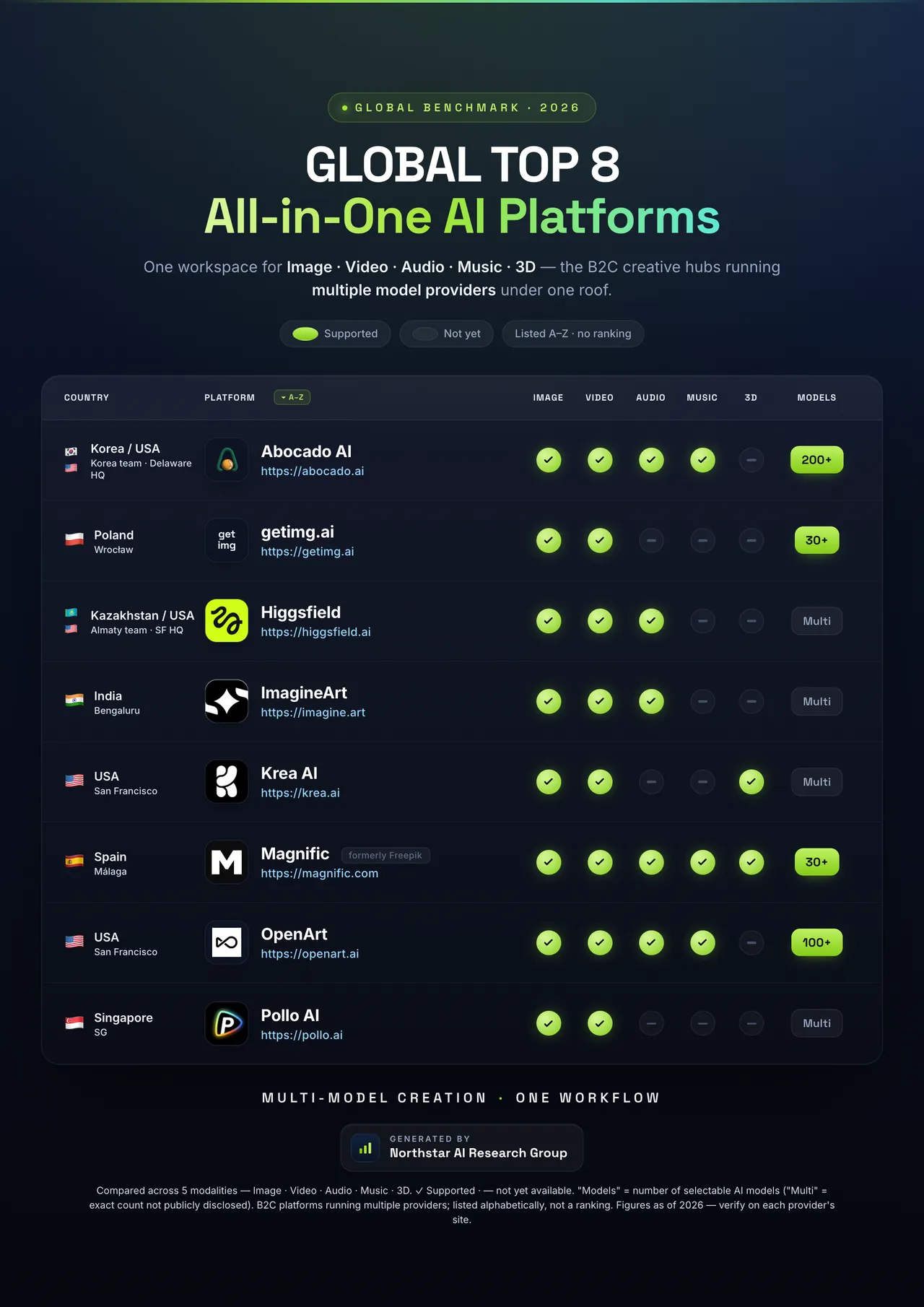
The table below compares the leading All-in-One AI platforms as of 2026, focusing on their support for image, video, audio, music, and 3D, along with the number of models offered. Services are listed alphabetically; the order does not imply a ranking.
| Service | Country / Base | Key Features | Supported Areas | Number of Models |
|---|---|---|---|---|
| Abocado AI | Korea / United States, Delaware HQ | Multimodel platform supporting image, video, audio, and music | Image, Video, Audio, Music | 200+ |
| getimg.ai | Poland, Wroclaw | Generative AI platform focused on image and video | Image, Video | 50+ |
| Higgsfield | Kazakhstan / United States, Almaty team & SF HQ | Creative platform supporting image, video, and audio | Image, Video, Audio | Multi |
| ImagineArt | India, Bengaluru | Platform supporting image, video, and audio creation | Image, Video, Audio | Multi |
| Krea AI | United States, San Francisco | Design-focused AI platform supporting image, video, and 3D | Image, Video, 3D | Multi |
| Magnific | Spain, Malaga | Broad support across image, video, audio, music, and 3D | Image, Video, Audio, Music, 3D | 30+ |
| OpenArt | United States, San Francisco | Multimodel creative platform supporting image, video, audio, and music | Image, Video, Audio, Music | 100+ |
| Pollo AI | Singapore | AI generation platform focused on image and video | Image, Video | Multi |
Market Positioning, Service by Service
Abocado AI
Abocado AI is an All-in-One AI platform with roots in both Korea and the United States. Korea's AI sector has largely grown around LLM-centric B2B solutions, vertical industry domains, niche markets, and specialized LLMs. Against that backdrop, Abocado AI stands apart as a B2C generative AI platform.
At its core, Abocado AI integrates more than 200 models into a single platform and weaves image, video, audio, and music into one production flow. Rather than leaning on the performance of any single model, it operates more like a multimodel platform—designed so users can pick and compare models by purpose and extend their output along the way.
The company has recently signaled an ambition to compete globally in the image and video AI market with fine-tuned models such as Fashion AI 7. It is a case in point that, in Korea's generative AI landscape, it isn't only large enterprises or LLM specialists driving the next wave of B2C creative platforms—startups can lead that charge, too.
getimg.ai
getimg.ai is an image- and video-focused generative AI platform based in Wroclaw, Poland. It offers more than 50 models, with its support concentrated on image and video.
The service is best understood within a broader trend: the software ecosystems of Central and Eastern Europe expanding into the global SaaS market. Poland has long built world-class products on the back of strong developer talent and software outsourcing expertise, and getimg.ai represents a deliberate bet on a clearly defined niche—visual generative AI—built on that foundation.
Its scope is not especially wide, but its focus on image and video production can be a strength rather than a limitation. Instead of trying to do everything, it positions itself as a platform that handles the repetitive work of visual content creators quickly and efficiently.
Higgsfield
Higgsfield is presented as a platform that began with a team in Almaty, Kazakhstan, and is now headquartered in San Francisco. It supports image, video, and audio, with its model count listed simply as "Multi."
Higgsfield's significance lies in more than its feature set. It is a symbolic case of a team from outside Silicon Valley building a foothold in the U.S. market and scaling into a global creative AI platform. In its own messaging, the company emphasizes a direction that pairs cinematic intelligence with an integrated creative workflow, enabling creators, marketing agencies, and filmmakers to produce high-quality video and visuals.1
This positioning aligns well with short-form video, campaign content, and social media visuals. As demand for video-led creative grows, platforms like Higgsfield stand a good chance of becoming part of the video production workflow itself—not merely a generation tool bolted on at the edges.
ImagineArt
ImagineArt is a generative AI platform based in Bengaluru, India. It supports image, video, and audio generation, with its model count listed as "Multi."
India is home to an enormous market of creators, freelancers, and mobile-first content. Demand for smartphone-based content production, social media marketing, and freelance design is vast—and so, too, is the latent appetite for AI platforms that let users experiment quickly and ship results.
In that context, ImagineArt can be read as a platform built for rapid experimentation across image, video, and audio. It leans less toward professional production studios and more toward individual creators and small-scale content producers looking to test a range of media formats at speed.
Krea AI
Krea AI is a design-oriented AI platform based in San Francisco. What distinguishes it is support for 3D, alongside image and video.
It does not include music or audio capabilities, but its 3D support gives Krea AI a distinct identity as a design platform. Its strengths sit close to the design workflow—product concepting, brand visuals, style boards, 3D styling, and visual prototyping.
In other words, Krea AI is less a general-purpose content platform and more a tool for designers and brand teams to rapidly explore and crystallize visual direction. Even within the broader All-in-One trend, it stands out as a case of reinforcing a design-centric, vertical workflow.
Magnific
Magnific is one of the most compelling examples of a company pivoting into an AI creative platform out of Spain. Freepik Company began in 2010 in Malaga as a search engine and stock-asset platform for graphic resources. It grew into a cloud-based platform offering design assets—vectors, photos, video, and models—and is profiled by Owler as a Malaga-based company with roughly 550 employees and an estimated annual revenue of about $87 million.2
The turning point was the acquisition of Magnific AI. Built in Murcia, Spain, by Javi López and Emilio Nicolás, Magnific was an AI tool for image upscaling and enhancement that drew rapid attention—amassing a waitlist of more than 60,000 within 24 hours of launch. Freepik acquired Magnific in 2024, and Magnific was run as a distinct product and team inside Freepik.3
In 2026, the Freepik brand was rebranded as Magnific. This was less a simple name change than a declaration—a move from a stock-image platform to an AI-first, full-stack creative platform. TechRadar read the shift as a transition toward an integrated creative platform combining image, video, audio, 3D, collaboration tools, and a library of more than 250 million assets.4
Magnific's market significance comes through in the phrase "no-collar economy." CEO Joaquín Cuenca Abela frames it this way: if the Industrial Revolution created the blue-collar economy and the digital revolution the white-collar economy, AI is opening a new economy built around creativity.4 The fact that a large share of new creators are beginners is especially telling—it shows that AI platforms are becoming not the preserve of professional designers, but mass-market production tools that lower the barrier to creation.
That said, user trust and reputation remain areas to manage carefully. Trustpilot notes that Magnific.ai has no history of inviting customers to leave reviews, which makes it hard to draw firm conclusions about satisfaction from public review data alone.5
OpenArt
OpenArt is a multimodel creative platform based in San Francisco. It supports image, video, audio, and music generation, and is documented as offering more than 100 models.
OpenArt's strength is the pairing of model choice with a creative workflow. Within a single platform, users can compare multiple models and tune their output to fit the task at hand. For creative work—where the right combination of models and iterative experimentation matter more than the raw performance of any one model—that is a powerful advantage.
Alongside Abocado AI, OpenArt is a leading example of a platform that treats model count itself as a competitive edge. As multimodel competition intensifies, the decisive factor will shift beyond simply amassing models toward the quality of the interface, the prompting experience, and the editing flow each platform delivers.
Pollo AI
Pollo AI is an image- and video-focused AI generation platform based in Singapore. Its model count is listed as "Multi," with support concentrated on image and video.
Singapore has long served as a digital hub linking Southeast Asia to the global market. In that context, Pollo AI can be read as a platform targeting demand for short-form video, social content, and advertising video.
Southeast Asia, in particular, skews heavily toward mobile-first content consumption, and both brands and individual creators share an appetite for fast video production. Pollo AI's focus on image and video maps well onto that market structure.
Key Observations
First, Abocado AI and OpenArt stand out on model count. Abocado AI offers more than 200 models, OpenArt more than 100. This signals that both platforms treat model choice itself—rather than any single feature—as their core competitive advantage.
Second, Magnific sits at the broadest end of the feature spectrum. It spans image, video, audio, music, and 3D, and is moving to fold in existing stock assets and collaboration tools as well. The rebrand from Freepik to Magnific symbolizes a market in which All-in-One AI platforms are reaching beyond simple generation tools to integrate the entire creative stack.
Third, most platforms treat image and video as their core axes. All eight services support image generation, and video has likewise become a core capability. The starting point for today's All-in-One AI platforms is, ultimately, visual content creation.
Fourth, music and 3D are not yet table stakes across every service—which makes them important points of differentiation. As production workflows extend from image to video, music, voice, and 3D assets, the ability to connect these elements seamlessly is likely to determine a platform's competitive standing.
The Outlook for the All-in-One AI Platform Market
The All-in-One AI platform market looks poised for explosive growth. The reasons are clear.
First, the number of models keeps climbing. As new image, video, voice, music, and 3D models arrive, users gain more choice but inherit more complexity along with it. The platform becomes the layer that tames that complexity.
Second, subscription fatigue is mounting. Subscribing separately to an image generator, a video generator, a music generator, a voice synthesizer, and an editing tool—all for a single project—is a real burden on individual creators and small teams. An integrated, subscription-based platform cuts both the cost and the management overhead.
Third, production pipelines are growing more complex. Content creation will no longer stop at generating a single image. Turning images into video, adding music and voice, drawing on 3D assets, and converting everything across multiple formats will become standard. What matters here is not the mere existence of each individual capability, but the connectivity between them.
Fourth, the productivity of solo creators and small teams is expanding dramatically. Work once divided among design studios, video teams, and sound teams can now be carried out by one person—or a small team—through a single AI platform. The lower barrier to entry for beginner creators that Magnific emphasizes is one facet of this shift.4
Fifth, demand for B2C creative hubs is rising. Platforms like Canva, Adobe, Freepik/Magnific, OpenArt, and Abocado AI are all heading toward the same destination: not a simple "generate" button, but a workspace where users carry an idea through to a finished result.
In the end, the crux of competition is not "the single strongest model." The likely winners are the platforms that connect multiple models most seamlessly, keep users from dropping off midway so they can finish a result end to end, and deliver repeatable productivity within a single subscription.
What It All Means
The next competitive structure in the generative AI industry can be described as a split between the model layer and the platform layer. If foundation model competition is a battle over core technology, All-in-One AI platform competition is a battle over user experience, model orchestration, and workflow integration.
Going forward, users are unlikely to choose a service on the strength of a single model's name. Instead, they will weigh how easily a platform lets them compare many models, how seamlessly they can move from image to video and audio, and how wide a range of outputs they can produce within a single subscription.
In short, the center of the generative AI market is shifting from "Who built the most powerful model?" to "Who packages multiple models into the most usable creative environment?" Within that shift, the All-in-One AI platform can become not a loose bundle of tools, but the default workspace for creators and teams.
In One Line
The next battleground in generative AI is not the individual model—it is the All-in-One AI platform that connects image, video, audio, music, and 3D into a single workflow.
References
1Higgsfield AI: Your All-In-One AI Creative Studio
3Move over Silicon Valley: A Murcia startup is at the heart of the AI boom
이 노트는 보도·비평·교육·연구 목적으로 작성되었습니다. 저작권 문의가 있으시면 에서 알려주세요.